We are guided by what unites people




News
Articles
Media
Announcement
 Chinese New Year
Technology
About Us
Contacts
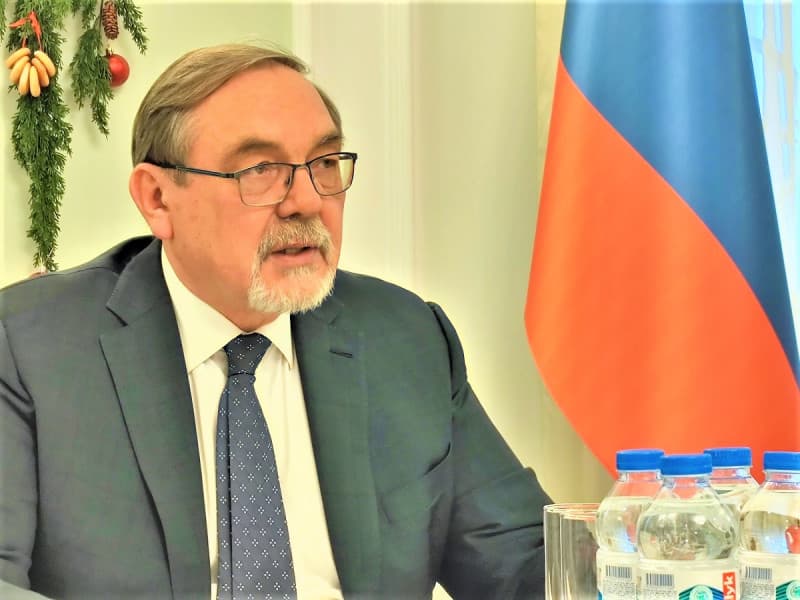
Chinese New YearAshgabat, January 16 | ORIENT. At a briefing in Ashgabat, Russian Ambassador to Turkmenistan Ivan Volynkin summarized the 2025 year in the history of bilateral relations and outlined the plans for 2026. We have identified the key trends that will shape the architecture of dialogue over the next 12 months.
Turkmenistan's CIS Chairmanship and Political Vectors
2026 will mark the 35th anniversary of the CIS, and Turkmenistan has assumed the Commonwealth's chairmanship.
Key date: October 9, 2026. The CIS Heads of State Council, with the participation of Russian President Vladimir Putin, will be held in the Avaza National Tourist Zone.
Next steps: A delegation from the Russian Foreign Ministry, led by Mikhail Galuzin, will arrive in Ashgabat on January 28–29. The topic is regional security. This is a "synchronization of notes" before the big political season.
Mishustin and Lavrov: Russian Prime Minister Mikhail Mishustin is expected to visit in the first half of the year (as part of the Council of Heads of Government), and Russian Foreign Minister Sergey Lavrov is expected to visit in October.
This high-level density of contacts makes Ashgabat a key "assembly center" for the renewed CIS coordinate system. The decision to hold the October summit in Avaza, rather than the capital, underscores the country's maritime gateway's status as a platform for discussing strategic North-South routes and Caspian security issues.
It is also clear that Turkmenistan is not simply fulfilling the rotating chairmanship in 2026, but is actively promoting the concept of the Commonwealth as a factor in global stability, where economic pragmatism prevails over political expediency.
From Numbers to Quality: An Economic Leap Forward
The Ambassador cited an impressive figure: a 35% increase in trade turnover in just 10 months of last year, significantly more than for all of 2024.
This is no longer just raw materials trade. This growth is driven by the work of the Intergovernmental Commission (led by Marat Khusnullin and Nokerguly Atagulyev) and the real sector.
Efficiency is also confirmed by the mobility of citizens and businesses: 120,000 visas have been issued, and the new e-visa option (already used by 10,000 people) has effectively erased bureaucratic barriers for business travel.
Humanitarian Development: University and School
In 2026, educational cooperation will enter the "major construction" phase.
Russian-Turkmen University: The project is in the "final stages of development." This will be an important educational hub that will cement Ashgabat's status as an intellectual center.
Pushkin School: The project for a new building for elementary grades is underway.
Human Capital: 54,000 students from Turkmenistan in Russia and a quota of 500 places is a long-term investment in the union of the two countries.
2025 Results: A Year of "Trust Diplomacy"
Last year laid the foundation upon which the current optimism rests. The Ambassador particularly noted the personal contributions of National Leader of the Turkmen People, Chairman of the Khalk Maslahaty (People's Council), Gurbanguly Berdimuhamedov, and President of Turkmenistan Serdar Berdimuhamedov.
Intensity at the Highest Level
Summing up the past year, Ivan Volynkin emphasized the exceptional dynamics of contacts between the leaders of the two countries. 2025 will be remembered for a series of visits by President of Turkmenistan Serdar Berdimuhamedov to Russia – in May for the anniversary of the Great Victory in Moscow and in December for the informal CIS summit in St. Petersburg. The year symbolically concluded with Vladimir Putin's visit to Ashgabat on December 12 to participate in a forum marking the 30th anniversary of the country's neutrality.
The Chairman of the Khalk Maslakhaty was a keynote speaker at the Kazan Economic Forum and held a series of substantive talks with the heads of Russian delegations, including a personal meeting with the Russian President in Ashgabat.
Departmental and Parliamentary Diplomacy
On the diplomatic front, a key event was Sergey Lavrov's June visit, which solidified the Foreign Ministry's cooperation plan for 2025–2026. The delegations' mutual visits covered a wide range of topics: from environmental issues in Altai to the participation of Russian Deputy Prime Minister Dmitry Patrushev in the UN conference in Avaza.
The diplomat also highlighted the following areas of cooperation:
Interparliamentary Relations: The visit of Mejlis Speaker Dunyagozel Gulmanova to Moscow was significant, culminating in the signing of a Cooperation Agreement with the Federation Council.
Humanitarian Missions: The visit of Oguljahan Atabayeva, a representative of the Gurbanguly Berdimuhamedov Charitable Foundation, to the Fashion Commonwealth Forum in St. Petersburg was an important step in developing social and humanitarian ties.
Multilateral Format: Interaction within the SCO+, the Caspian Five, and the SPIEF confirmed the closeness of Ashgabat and Moscow's positions on the global agenda.
Spirit and Memory
The Alley of Memory near the embassy and the Immortal Regiment march, which attracted 1,500 people, became an important symbol of the year. This demonstrates that the unity of Ashgabat and Moscow is based not only on pragmatism but also on a shared history.
If 2025 was a year of "records," then 2026 will be a year of "implementation." Ashgabat officially becomes the main diplomatic platform of the CIS, and humanitarian and economic projects (from education to transportation) are taking shape.