We are guided by what unites people




News
Articles
Media
Announcement
 Chinese New Year
Technology
About Us
Contacts
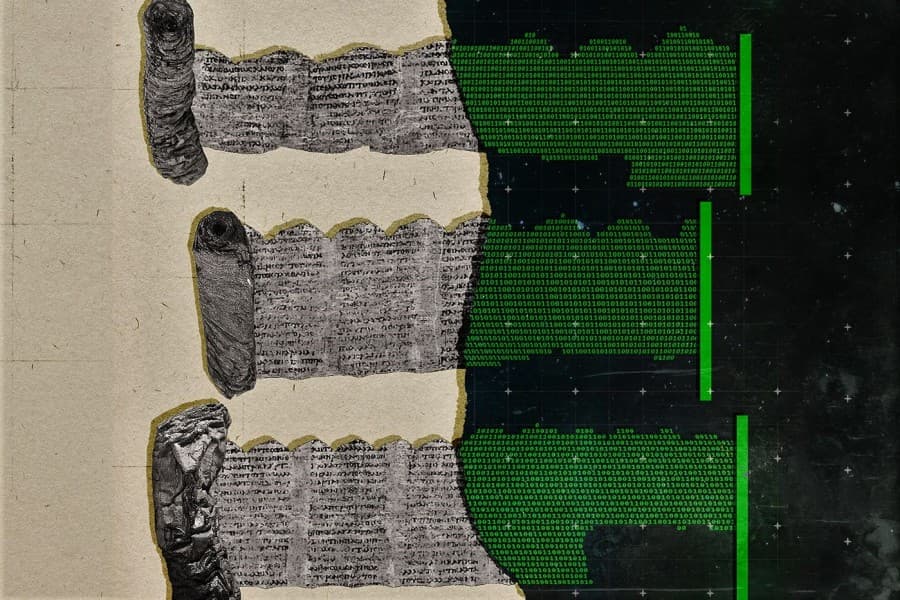
Chinese New YearTwo millennia after the eruption of Vesuvius, which destroyed Pompeii and the neighboring city of Herculaneum, scientists were able to read the texts on charred scrolls, previously considered irretrievably lost "black stones."
The Mystery of the "Villa of the Papyri." Excavations in Herculaneum uncovered the only surviving ancient library—hundreds of papyrus scrolls. But there was a problem: the heat of the eruption had turned them into brittle charcoal. Any attempt to unroll one of these scrolls resulted in it crumbling to dust in the hands of the researchers.
"Virtual Unfolding" Technology. The breakthrough was achieved thanks to the Vesuvius Challenge, a project bringing together papyrologists and machine learning specialists. Professor Brent Seales' team from the University of Kentucky developed a method of computed tomography with incredibly high resolution: the scroll is exposed to X-rays, creating a 3D model of its internal structure; AI algorithms detect the boundaries between the thinnest layers of burnt papyrus and "unfold" them on a computer screen. The most challenging aspect is that the soot-based ink is almost identical in density to burnt papyrus. The AI was trained to recognize microscopic changes in the surface texture left by the pen of an ancient scribe.
What Did the Scrolls Reveal?
The first deciphered fragments, confirmed by experts in April 2026, revealed a previously unknown philosophical treatise. The author discusses how music, food, and art influence happiness.
"It's like a miracle. We've peered into a library sealed by fire two millennia ago. Now we can not only see these scrolls, but also hear the voices of their authors," Brent Seales notes in a publication for the journal Nature.
This discovery proves that future technologies can restore our lost past. If scientists succeed in reading all 800 scrolls of the Villa of the Papyri, the volume of known Greco-Roman literature could increase severalfold. This represents a chance to discover lost works by Aristotle, Sophocles, or unknown historical chronicles.
April 2026 Update: Automating the Miracle
While just a year ago, deciphering every centimeter of charred papyrus required months of manual programming, this week (April 6, 2026), the organizers of the Vesuvius Challenge announced a new victory.
Thanks to an open developer competition, next-generation algorithms were created that:
Automatically detect layers: AI now automatically "sees" the boundaries of burned sheets in 3D scans with pinpoint accuracy.
Eliminate distortions: New "mathematical smoothing" methods allow the text to be seen without the interference previously caused by folds and cracks in the coal.
Scaling success: Scientists are now ready to move from reading individual fragments to deciphering hundreds of library scrolls en masse.
"We have moved from proving the very possibility of reading to the industrial-scale reconstruction of history," the organizers emphasized in the project's official blog on April 6.
As AI refines reading algorithms, the artifacts themselves are becoming centers of attraction for the global public. This week, four authentic scrolls from Herculaneum are on display at a special exhibition in Utah, USA. Scholars gathered for the "The Buried Library" conference note that we are on the verge of discovering an entire library of lost works by ancient philosophers.