We are guided by what unites people




News
Articles
Media
Announcement
Technology
About Us
Contacts
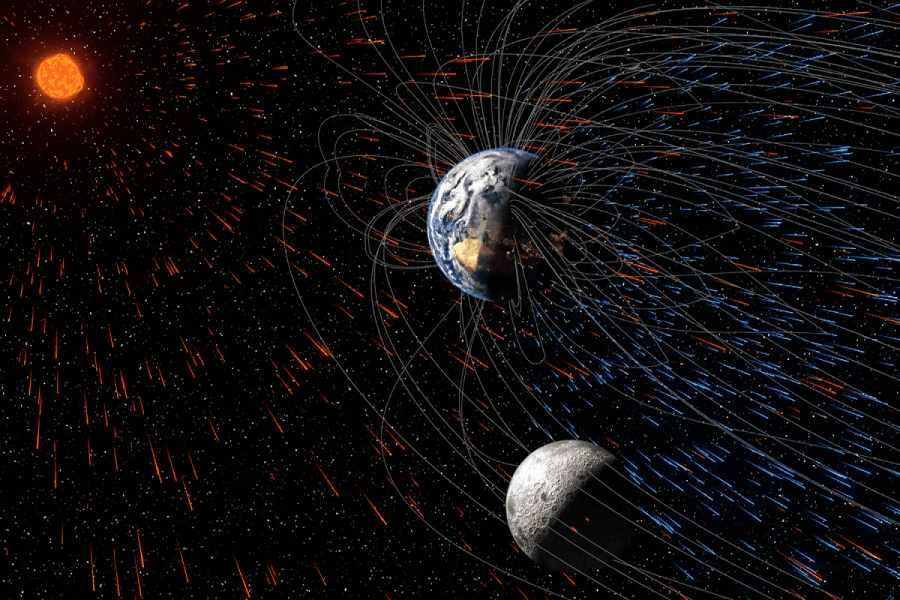
Science | ORIENT. The Moon has always been considered a lifeless and isolated satellite, but recent research is forcing scientists to reconsider this theory. It turns out that the Earth and the Moon are much more closely connected than they appear: our planet has literally been "feeding" its satellite particles from its atmosphere for billions of years.
A new study from the University of Rochester, published in the journal Nature Communications Earth and Environment, shows that Earth's magnetic field may actually help channel atmospheric particles carried by the solar wind into space, rather than block them. Because Earth's magnetic field has existed for billions of years, this process could have steadily transported particles from Earth to the Moon over very long periods of time.
How does this happen? Thanks to Earth's powerful magnetic field, tiny particles of oxygen and nitrogen from the upper layers of our atmosphere are drawn into space, forming an invisible plume. When the Moon passes through this "magnetic tail" of Earth, it captures these particles.
These research findings suggest that lunar soil may not only preserve long-term information about Earth's atmosphere but may also be even more valuable than previously thought for future space explorers living and working on the Moon. Elements such as water and nitrogen could support a sustainable human presence on the Moon, reducing the need for cargo transportation from Earth.
What does This Mean for Science?
The Moon as an archive: This means that lunar regolith (soil) may preserve samples of Earth's ancient atmosphere, as it existed 2-3 billion years ago. By studying the Moon, we can learn how Earth's climate changed during the era when life emerged.
A cosmic "umbilical cord": The discovery proves that neighboring planets can exchange matter. This gives hope to scientists searching for life on the moons of Jupiter and Saturn—perhaps they, too, receive nourishment from their giants.
This invisible yet continuous flow of life between Earth and the Moon reminds us that space is not completely alone—everything is connected by invisible threads of gravity and magnetism.