||




 Chinese New Year
If you opened the news today and saw Bitcoin plummeting again, while metals and materials are acting like they have their own sales force, you're not alone.
• According to Reuters, Bitcoin fell to ~$63.3k, and the cryptocurrency market has lost around $2 trillion since its autumn peak. (Reuters)
• Simultaneously, Reuters reports that copper on the LME soared above $14,000/t, briefly reaching $14,527.50/t, amid expectations of demand and speculative buying. (Reuters)
And here's where the real business part begins: when copper and metal prices rise, it quickly trickles down into estimates – cables, fasteners, pipes, power tools, components, ventilation, panels, and automation. Even if you don't buy copper, you're buying everything saturated with it.
And now the good news: in periods like these, the winners aren't those who "time the market," but those who buy with discipline and spot cheaper alternatives before anyone else. That's exactly what ALSAT is for.
1) Remove "panic markups" from purchases
When the market is volatile, two things usually happen:
Suppliers raise prices "just in case”.
The buyer overpays "just in case."
At these times, it's helpful to have a source where wholesale is truly wholesale, and where products are often discounted from the market. On ALSAT, according to the platform itself, items are often sold at discounts of 50%+, and savings of up to 89% have been recorded for certain items.
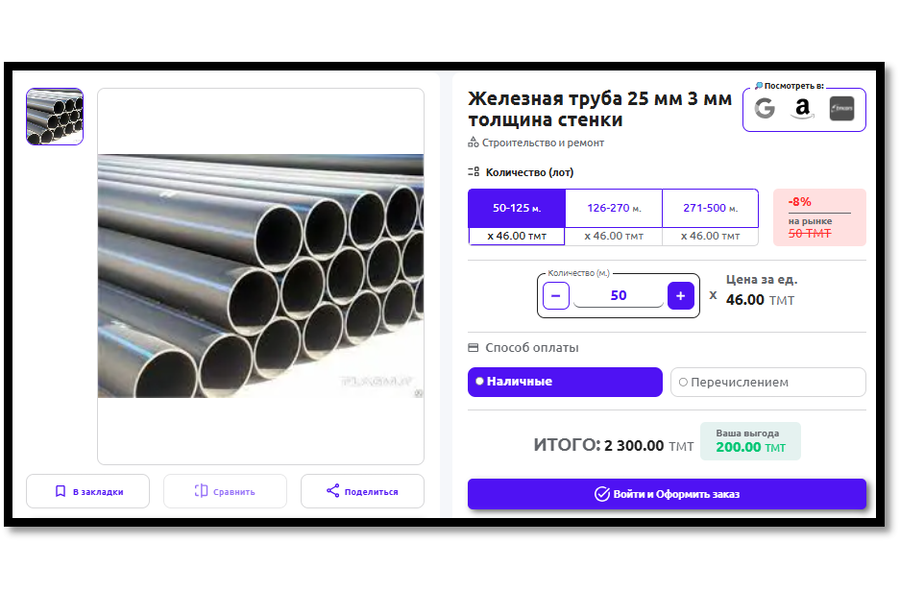
To avoid sounding like a "vacuum" advertisement, here's an example of the mechanics right on the product card: a 25mm iron pipe is shown with a benchmark of "50 TMT on the market," while the price on ALSAT is 46 TMT (-8%).
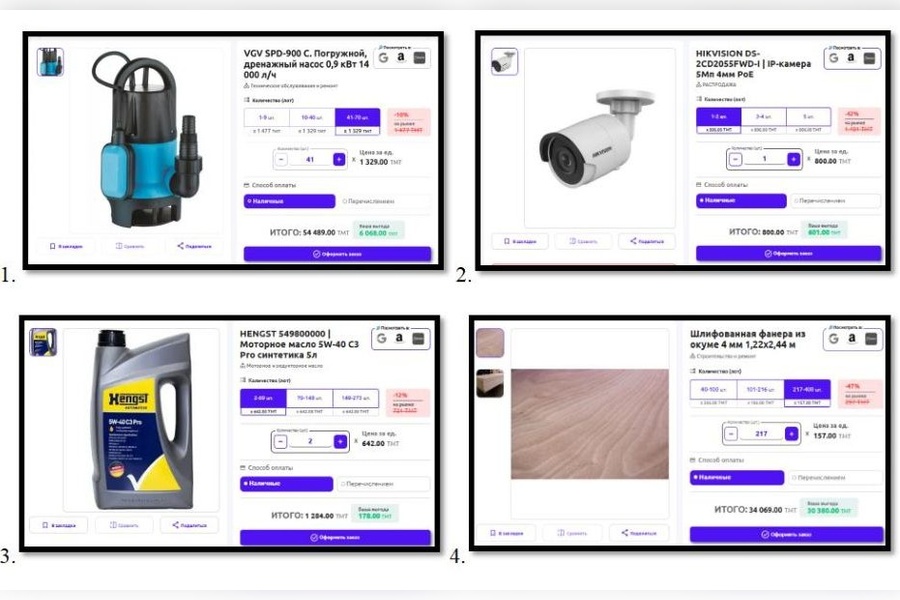
This is the very essence of "anti-hysteria": you see the benchmark, not buy by ear. These are just a few examples; you can find more below:
2) Bargaining without awkwardness: "Shall we haggle?" is now a button, not a conversation
There are negotiations where you bargain confidently.
And there are negotiations where you haggle... as if asking for salt in a restaurant.
ALSAT has a proper, adult option for this: the "OFFER CHEAPER" button is available on every product page. You submit an offer and can receive an additional discount.
Translated into business language: negotiation becomes a process, not an emotional sport.
3) RFQ instead of 17 calls: purchasing "according to the list" in 2 business hours
If your procurement isn't "one item," but rather "we need this, this, and this, preferably yesterday," the fastest way is:
Send your RFQ to rfq@alsat.biz or directly on the website and receive a selection of available listings, usually within two business hours.
Plus, if you're purchasing regularly, the logic is even more convenient through your account: upload the file, see statuses and results, receive notifications—less chaos, more control.
Yes, it sounds like "why couldn't it always be like this?" Because everyone loved to suffer in the past.
4)A professional procurement lifehack rarely used by SMEs: "Should-Cost on a Napkin"
There's a procurement technique that's very popular among strong procurement teams (and rarely used by small and medium-sized companies): should-cost – an estimate of how much a product should cost based on cost drivers and the market, not the seller's sentiment.
Why is this important now, when metal and materials prices are rising: if you don't understand "how much it should cost," you're negotiating blindly.
• In UK practice (Government Commercial Function), should cost modeling is described as a tool that helps understand "what it should cost" and reduce the risk of choosing an offer solely because it's the "cheapest" (low-cost bid bias). (GOV.UK Publishing)
• Industry reviews of procurement note that should costing relies on a clean-sheet approach to assess supplier costs and margins and negotiate more intelligently. (Supply Chain Digital)
How to simplify this to the SME level (a "quick fix" option, but still effective):
1.Identify the "raw material tail" (metal/copper/aluminum/plastic) – roughly estimate its share of the price.
2.Add logistics and conversion (processing, cutting, packaging, delivery).
3.Include a reasonable supplier margin (not "because the crypto market has fallen").
4.Once you've reached a fork, you either:
• o negotiate confidently,
• o or immediately switch to alternatives (and here ALSAT is useful because the alternatives are already "in one place").
It's not magic. It's a way to avoid funding someone else's panic raising.
5)"Cheaper" isn't always "better": ask for three digits in your answer
When the market is tense, it's important to ask for more than just the price. Ask for three parameters for each item:
• price,
• shipping time,
• price/availability lock-in period (e.g., 24-72 hours).
Why this works: You compare offers like adults, not like "who responded first on WhatsApp." And there are fewer rounds of negotiation.
6)For sellers: Now is your time (if you don't miss the RFQ flow)
When materials become more expensive, buyers start looking for:
• similar items,
• available inventory,
• quick delivery,
• "here and now" options.
RFQ creates a flow of inquiries "at the time of purchase," not "just inquiries." This means it's important for sellers to:
• keep product descriptions clear,
• respond quickly,
• offer 2-3 options (in stock/similar/on order).
It sounds trivial, but it works: buyers choose not the lowest price, but the most straightforward scenario for meeting their needs.
What can be done today (without heroism)
1.Create a "critical" list 2-4 weeks in advance (things without which the project will stall).
2.Send your RFQ to rfq@alsat.biz– expect the selection to arrive "in 2 hours," not "when everyone wakes up."
3.Use "OFFER YOUR PRICE" on the items you find – negotiating should be a button, not a stressful experience.
4.Use "should-cost" on a napkin – and negotiate with numbers, not emotions. (GOV.UK Publishing)
And most importantly
The market can be a roller coaster ride every day, but procurement must follow a set pattern, like the
Website: https://alsat.com.tm