We are guided by what unites people




News
Articles
Media
Announcement
 Chinese New Year
Technology
About Us
Contacts
Chinese New Year "They say astronomy instills modesty and strengthens character. Perhaps there's no better demonstration of human conceit than this detached picture of our tiny world."
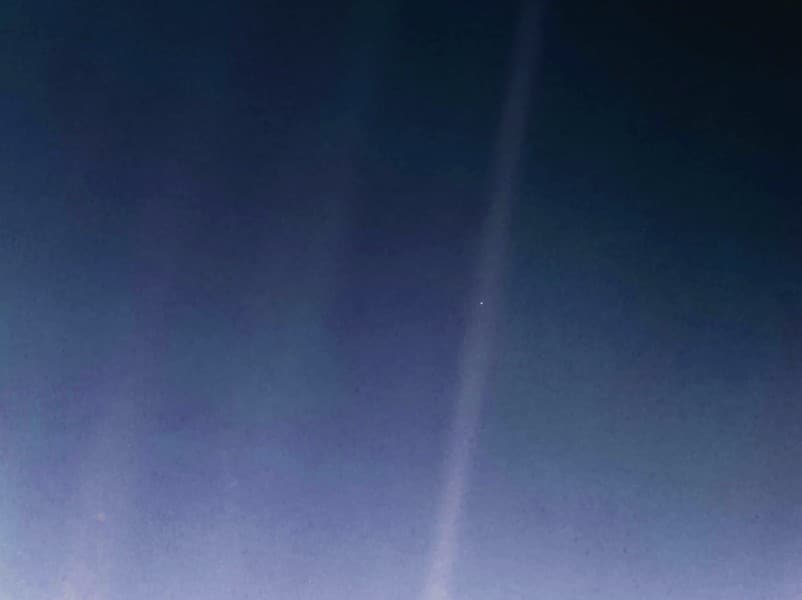
Who said this? What picture are we talking about? And why is it worth reading about this on Valentine's Day?
You'll find out the answers very soon. But first, a few words about how space has long been a mirror in which humanity sees not only technological progress but also its own essence.
The topic of space has been raised repeatedly on the pages of ORIENT: from stories of the heroism of female cosmonauts and the thousands of days spent in orbit by Hero of Turkmenistan Oleg Kononenko, to photographs of our capital taken by the world's first scientist-commander of a spacecraft, Sergei Ryazansky, and a French astronaut's reflections on the Karakum Desert in the context of the film "Dune".
The "ORIENT Will Fly into Space" project is further proof that the editorial team, like the country as a whole, closely follows the stellar horizons, perceiving space as a realm that reflects both scientific ambitions and humanitarian values.
Last year, we celebrated the 10th anniversary of the launch of the first national communications satellite, "Türkmen Älem 52°E." This event symbolized the confident steps taken by Turkmenistan—a state with a permanent neutrality and a peaceful foreign policy—on the path of scientific and technological development and strengthening the human-space connection.
However, today it is important to discuss not only technology and discoveries, but also the humanitarian side of space. Space is not only rockets and orbital stations, new scientific horizons, or an arena for an arms race (which is inhumane in itself). It is also a reminder that Earth is, for now, our only common home.
Incidentally, the opening quote is by Carl Edward Sagan, an American astronomer, astrophysicist, and philosophical writer. His book, "Pale Blue Dot: The Cosmic Future of Humanity"*, was not just a scholarly work but a profound philosophical reflection on humanity's place on Earth and in the Universe.
Sagan was a remarkable figure. His supporters noted his invaluable contribution to the popularization of natural sciences and his defense of the principle of open research—without national or other barriers. He opposed the militarization of science, criticized its reactionary use, and opposed ideas that could lead to global catastrophes. For him, the Universe had no center—neither geocentric nor anthropocentric. This was the essence of his true philosophy of humanism.
Indeed, space is not simply an object of scientific study, but a profound part of human existence, reflecting our connection to the entire universe and its laws. As Sagan wrote, "The cosmos is within us. We are made of star stuff. We are the cosmos's way of understanding itself."
Many considered Sagan an atheist or agnostic, based on his statements. However, it would be more accurate to call him a humanist—a man for whom humanity's responsibility to itself, to life, and to future generations was paramount.
That is why the photograph of Earth taken by the Voyager spacecraft on February 14, 1990, from the edge of the solar system (from a distance of approximately 6 billion kilometers) became for him not just a scientific document, but a philosophical revelation. In this image, Earth appeared as a tiny "pale blue dot," barely visible in a beam of sunlight.
That's why the photograph of Earth taken by the Voyager spacecraft on February 14, 1990, from the edge of the solar system (at a distance of approximately 6 billion kilometers) became for him not just a scientific document, but a philosophical revelation. In this image, Earth appeared as a tiny "pale blue dot," barely visible in a beam of sunlight.
Sagan saw in this image proof of the fragility and uniqueness of our home. He wrote that this dot reminds us of the futility of war, the senselessness of hatred, and how insignificant our conflicts are in the grand scheme of things.
And here a direct connection emerges with our time: the desire for peace, trust, and cooperation is not an abstract dream, but a pressing necessity if we are to preserve this abode!
Subjectively speaking, while trying to combine the theme of space and Valentine's Day, which we celebrate today, in this article, I couldn't help but recall Christopher Nolan's sci-fi film Interstellar. Specifically, one of his key quotes:
"Maybe love is something more than we can currently comprehend. Maybe it's evidence of something else, an artifact of another dimension we can't access. Love is the only feeling that can transcend time and space. Perhaps we should trust it, even if we don't fully understand its nature."
Ultimately, looking at the "pale blue dot," it's impossible not to reflect on how all of humanity shares a single destiny—the destiny of a tiny planet in the boundless ocean of space. And love for it, for ourselves, for our loved ones, and even for those far away—this is perhaps the only thing that can preserve this shared "pale blue dot."
Djumadurdy Potdjimov
*Carl Sagan. The Pale Blue Dot. The Cosmic Future of Humanity. – 1997. – Pp. 12-13. Translation from English:
"Look again at that dot. Right here. This is our home. This is us. Everyone you love, everyone you know, everyone you've ever heard of, every human being who ever lived, lived out their lives on it. The multitude of our joys and sufferings, thousands of self-righteous religions, ideologies, and economic doctrines, every hunter and gatherer, every hero and coward, every creator and destroyer of civilizations, every king and peasant, every couple in love, every mother and father, every bright child, inventor and explorer, every moralist, every lying politician, every "superstar," every "greatest leader," every saint and sinner in the history of our species lived here – on a speck of dust suspended in a sunbeam.
The Earth is a very small stage on a vast cosmic arena. Think of the rivers of blood spilled by all those generals and emperors so that, in the blaze of glory and triumph, they could become the momentary masters of a fraction of a grain of sand. Think of the endless atrocities perpetrated by the inhabitants of one corner of this dot on the barely distinguishable inhabitants of another corner. Think of how frequent the disagreements between them are, how eager they are to kill each other, how fervent their hatred.
Our posturing, our imagined importance, the illusion of our privileged status in the universe—all of them crumble before this point of pale light. Our planet is but a lonely speck in the surrounding cosmic darkness. In this vast emptiness, there is no hint that anyone will come to our aid, to save us from ourselves.
Earth is currently the only known world capable of supporting life. We have nowhere else to go—at least in the near future. To visit, yes. To settle, not yet. Like it or not, Earth is our home now.
They say astronomy instills humility and strengthens character. Perhaps there is no better demonstration of human conceit than this detached view of our tiny world. I think it underscores our responsibility, our duty to be kinder to one another, to preserve and cherish the pale blue dot—our only home.