||




 Chinese New Year
A week is coming to an end that future history books will likely call the point of no return for global energy. The events of recent hours—from the mothballing of Qatari gas to the strikes on the Persian Gulf's nerve centers—have created a situation in which the old rules no longer apply.
As for the mothballing of Qatar's LNG plants, this is a long-term commitment. The technological complexity of the process is such that the world has lost a fifth of its gas supplies for months, and possibly years. Therefore, whether we like it or not, changes in the way humanity lives, regardless of the outcome, will occur. At least, there should be...
Brent crude, after rising and falling, is ending the week at $111.40. Gas in Europe is hovering at a frightening $1,350. Gold reached a historic high of $2,192 per ounce, becoming a reliable anchor in a sea of depreciating currencies.
Against this backdrop, predictions of the demise of the "petrodollar" standard are becoming increasingly vocal. These are no longer just rumors, but harbingers of a fundamental reform of the entire structure of global trade. Before our very eyes, the world is disintegrating not into ideological blocs, but into energy blocs. Fossil fuels, having weathered the initial shocks of the "green revolution," are regaining their status as the leading currency, and mutual settlements are rapidly diversifying in favor of national currencies.
The beginnings of this process are clearly visible not only in large associations like BRICS or the EAEU, but also in our region. At the Central Asian Heads of State Summit in Dushanbe, the presidents announced a gradual increase in the share of national currencies, as ORIENT previously reported in detail.
Energy hunger is forcing the world to reconsider its old phobias. South Korea is attempting to return to coal-fired power generation, while Japan, frightened by previous accidents, is still striving to restart large nuclear power plants. The coming fruits of nuclear energy development are gradually softening the collective memory of Fukushima and Chernobyl.
Obviously, when conventional fuel returns to the market in sufficient quantities, prices for "black gold" will stabilize naturally. But the strategic shift is abandoning the dictatorship of a single currency in resource payments.
Is it possible? The answer will become more or less clear after the Hormuz adventure is concluded. Energy is the DNA of civilization, the foundation of modern society. When oil supplies are cut, it impacts not only the gas tank of a car, but also the production and transportation of almost everything—plastics, medicine, clothing, food, and so on.
Researcher at the Belt and Road Center for International Development Qu Qiang reveals the essence of what's happening: the world is losing more than half of its usual traffic through logistics bottlenecks. A Beijing expert confirms a drop in traffic from 20% to 10%, which sounds almost like a death sentence for maritime logistics.
The world is losing more than half of its usual traffic through maritime straits. The rational conclusion is obvious: the era of cheap and easy logistics is over, and geography has once again become the decisive factor.
Министр иностранных дел Ирана Аббас Арагчи подтвердил, что Ормузский пролив де-факто закрыт для судов США, Израиля и их союзников, а риски безопасности вынуждают большинство перевозчиков нефти вообще избегать этого региона. Foreign Minister of Iran Abbas Araghchi confirmed that the Strait of Hormuz is de facto closed to vessels from the US, Israel, and their allies, and security risks are forcing most oil carriers to avoid the region altogether.
The situation in the straits has thus become not only a global economic problem but also a cynical business venture. Reports that shipowners are being forced to unofficially pay $2 million for safe passage through the Strait of Hormuz confirm that maritime logistics is already becoming hostage to extortion.
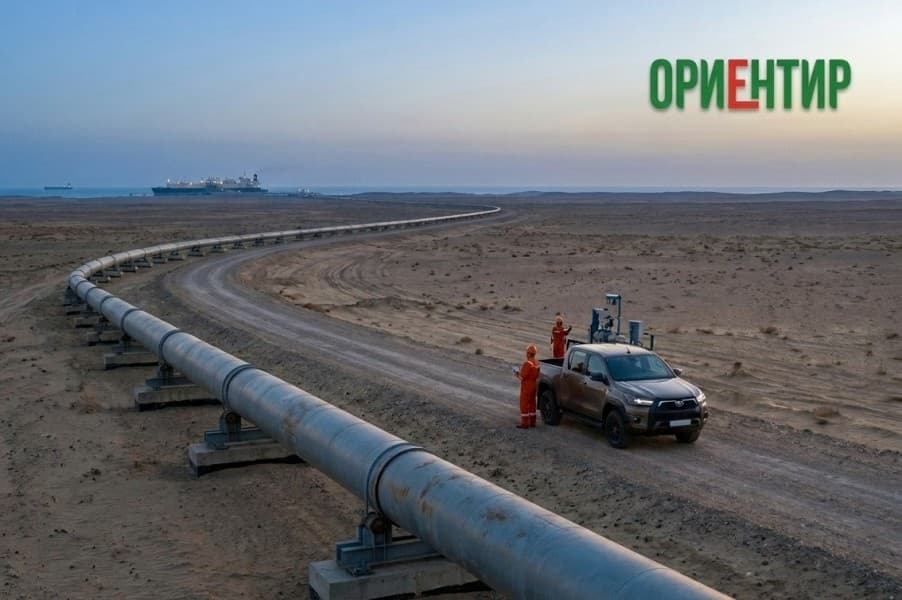
Against this backdrop, Central Asia's onshore pipelines are becoming (we repeat once again) a true security corridor. This is a space where fear is not a premium, but rather reliability is guaranteed by contract.
Bekdurdy AMANSARIEV