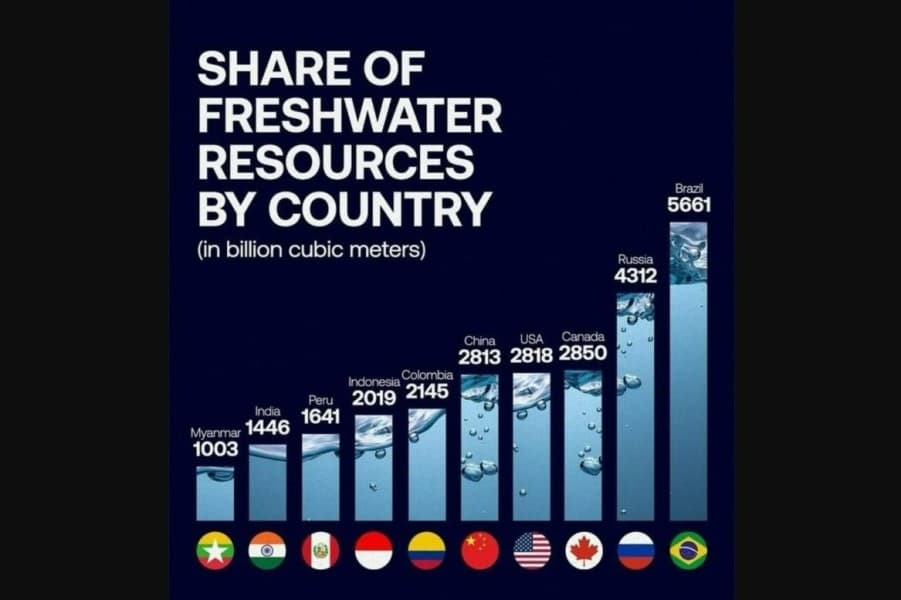



In an era when freshwater scarcity is becoming the "new oil" of global politics, the distribution of water resources across the planet appears extremely uneven.
According to the data of the World Bank, the bulk of the world's reserves are concentrated in the hands of just a few countries, while other regions teeter on the brink of humanitarian catastrophe.
Water Ranking Leaders
Brazil tops the list of countries with the most water resources. Thanks to the vast Amazon basin, the country has an incredible 5,661 billion cubic meters of freshwater.
The top five global leaders by resource volume are:
- Brazil — 5,661 billion m³
- Russia — 4,312 billion m³
- Canada — 2,850 billion m³
- USA — 2,818 billion m³
- China — 2,813 billion m³
Water-rich countries also include Colombia, Indonesia, and Peru, due to their tropical climates and powerful river systems.
The paradox of plenty: why don't reserves quench thirst?
Having vast reserves doesn't mean there are no problems. Experts point to two critical factors that complicate the situation:
Geographic gap: In Brazil, most of the water is concentrated in the Amazon, far from densely populated São Paulo. In Russia, the colossal resources of Siberia are difficult to access for industrial centers in the European part of the country.
Demographic pressure: India (1,446 billion m³) and China rank among the top in absolute reserves, but due to their huge populations and rapid industrialization, both countries are experiencing severe water stress per capita.
2030 Forecast: Demand Will Outstrip Supply
The World Bank warns that at current consumption rates, global water demand could exceed supply by 40% by 2030.
The main consumers remain agriculture (accounting for approximately 70% of all global freshwater consumption); urbanization and population growth; and climate change, which is altering precipitation patterns and turning once-fertile lands into arid zones.
Today, water resource management is not just an environmental issue, but a strategic security challenge. Governments around the world are increasing investments in reservoir construction, desalination plants, and precision irrigation technologies to prevent a global crisis.