We are guided by what unites people




News
Articles
Media
Announcement
 Chinese New Year
Technology
About Us
Contacts
Chinese New Year The French Embassy and the French Institute in Turkmenistan presented local audiences with an exceptional event to mark Francophonie Month 2026. As part of this large-scale celebration of French culture, pianist Christine Vonlupt, a prominent figure on the contemporary European music scene, visited the capital. Her Asian tour features a unique program, "Women's Icons." This musical canvas is woven from two opposing perspectives: on the one hand, the admiring male gaze on feminine nature, as seen in the works of such geniuses as Bizet, Ravel, and Debussy; on the other, the profound, sincere music of female composers Cécile Chaminade and Mel Bonis, whose names are now triumphantly returning to the international stage.
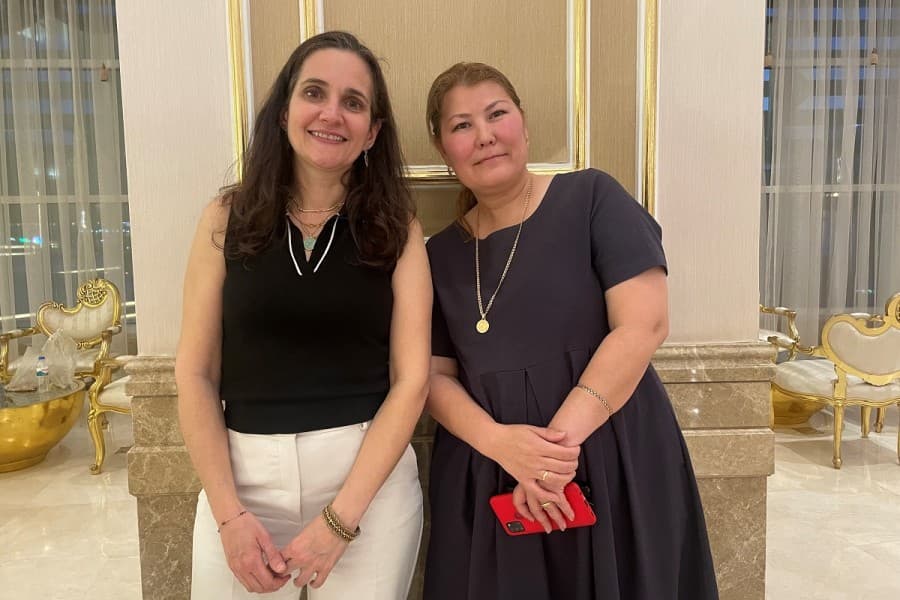
Christine agreed to an interview with ORIENT readers. The interview was conducted by journalist and composer Aina Shirova. The interview was conducted in French, which allowed us to get to the very heart of the guest's musical philosophy.
-What's the secret of the "French touch"? They say French pianists have a unique way of touching the keys: light, almost invisible. Is this unique sound production a myth passed down from generation to generation in conservatories, or a genuine sensation of "air" beneath the fingers?
-When performing pieces, I strive to create a soundscape, meaningfully conveying the musical text, as if speaking it. This is how the concept of French touché emerged. Working with vocalists at the Comédie-Française, I often encountered questions of phraseology and pronunciation. Vocal music exists in many languages, and each has its own unique rhythm and coloring. The French have a naturally highly developed ear, due to the peculiarities of the language. We distinguish between long and short consonants and vowels. This shapes the phraseology in music and the speed of performance.
— There's been some mention in the press of your "Piano Orchestra" project. It was born out of the idea that almost any orchestral instrument can be used to form an ensemble or orchestra. But the piano is always left alone. So, you decided to create an orchestra consisting solely of pianos. You gathered 100 pianists for the project. What's it like to hear 8,800 keys playing simultaneously? It must be like operating a gigantic machine or trying to tame the elements?
— The project is truly ambitious. And even a little crazy. We installed 50 electronic pianos on the stage of the Paris Philharmonie. Each instrument is manned by two players, playing four hands.
— And how are the roles distributed in the orchestra? Like in a regular orchestra? Someone plays the basses instead of the double basses, while others replace the flutes...
— Not exactly. We break the work down into main themes, supporting voices, motifs, rhythmic groups, and harmonic support. And each participant has their own unique role. The orchestra is made up of children between the ages of 10 and 16. Among the fifty electronic pianos that serve as the orchestra, there is one acoustic grand piano—for the soloist. This soloist is usually a highly skilled, virtuoso pianist, a winner of national competitions. We distribute the parts to the others so that they can play comfortably and easily. We assign more complex parts to older pianists, while younger students (the youngest of whom is 8 years old) are assigned to play a passage that is appropriate to their age and skills.
-And it gives hundreds of pianists a great opportunity to take to the big stage.
-Exactly. For both them and their parents, going on stage is a significant moment. Our repertoire is based on well-known classical and contemporary compositions, which we specifically adapt for the piano orchestra. However, we also have exclusive works created for this project. For this purpose, we announced competitions for young composers. And we currently have several works written specifically for our orchestra."
-And does this orchestra have a conductor?
-Yes, sometimes I conduct myself."
-Your repertoire includes a lot of Astor Piazzolla. How does your passion for tango coexist with the academic rigor of classical works?
-My connection with Piazzolla was by chance: a violinist was looking for a partner for a tango and asked me to partner her. Until then, my world had been focused on the academic repertoire, but this experience opened up a completely different dimension of music.
Tango is not a conflict between passion and rigor, but their perfect symbiosis. Piazzolla's music is much more rhythmic and vertical, in pianist terms, than traditional classical music. Tango demands iron discipline: every accent must be extremely sharp, and the touch of the keys precise and dry, like, for example, in rock music.
In a classical piece, we often seek a flexible line, but in tango, the rhythmic framework is paramount. It is a work at the intersection of impeccable technique and extreme emotional concentration.
While working on a project related to Piazzolla's music, I quickly realized that a passion for tango and the rigor of classical music are not enemies. Piazzolla himself was a student of the great Nadia Boulanger, and his music has a strong academic foundation. For a pianist, this is incredibly interesting: you must maintain impeccable control and rhythmic precision, yet allow the sound to be fiery, sharp, and alive.
— In Ashgabat, you performed the program "Women's Icons." It's a certain balance: music by men about women (Bizet, Ravel) and music by female composers themselves, Cécile Chaminade and Mél Bonis. It's well known that Bonis, due to the stigma she faced in French society in the late 19th and early 20th centuries, had to hide her real name, Mélanie, under a male pseudonym. The preface to the concert also stated that the theme of feminism is part of French diplomacy. Hence the question: do listeners hear the difference in “gender” in the notes, or when the music.
-When music is truly great, it becomes universal and transcends biology. For me, something far more important is individuality and sincerity of expression. The inner world the composer imbues into the sounds, its energy and depth, is crucial.
In my program, the juxtaposition of Bizet, Ravel, Debussy, and women composers is not a gender juxtaposition, but a dialogue of different personalities and states of mind. Sometimes music written by a woman proves far more powerful and forceful than that of a man, and vice versa. Ultimately, when the lights go down and the first bar rings, pseudonyms and biographies cease to exist. All that remains is pure art, which transcends all definitions. No listener can determine the gender of a composer by ear. The goal of my concert program is to prevent the works of women composers from disappearing. After all, there are some very talented authors among them. Compared to the vast number of works written by men, the percentage of works written by women is very small.
-But don't you think Chaminade and Bonis were more sincere in their music than those great men who merely attempted to "decode" the female soul?
-When Bizet and Ravel write about women, they paint a myth, a beautiful portrait from a distance. It's a brilliant "decode," as you rightly noted, but it's always a distance. But in the music of Cécile Chaminade or Mélanie Bonis, there's no distance. Their music isn't an attempt to decipher something, but rather their very existence, their everyday life, their inner silence and struggle. In their notes, we hear not a "female image," but a living human "I" that needs no explanation.
Sincerity has no gender. Sincerity is the composer's honesty with himself. And if the music of Chaminade or Bonis touches us so deeply today, it's not because they were women, but because they found the courage to be utterly truthful in their sounds.
— Cécile Chaminade wrote in a style close to Debussy's arabesques—light and virtuosic. But where Chaminade was often criticized for the "excessive femininity" of this lightness, Debussy, on the contrary, was praised for the same qualities. What Debussy considered "impressionism" and a search for new colors, Chaminade condescendingly called "salon elegance." Doesn't this seem like a form of historical injustice, when a composer's gender determined the value of their music?
— For me as a performer, something else is important. When I sit down at the piano, those gender labels of the past disappear. Chaminade's arabesques require the same filigree technique, intellectual control, and profound work on sound as Debussy's works. In her music, behind the light façade, lies a highly complex harmonic structure and an impeccable sense of form.
Today we return to the very essence: the value of music is determined not by the gender of the composer, but by the quality of the composition. My task is to play Chaminade with the same respect and seriousness with which we approach recognized classics. Justice is restored not in the discussions of musicologists, but in the concert hall, when the listener understands: this music is great in itself, without any allowance for biography.
— When studying the scores of Chaminade or Bonis, have you found any purely "feminine" techniques or logic that a male composer would never have guessed?
— You know, I don't believe in the existence of "feminine" techniques or any special "feminine" logic in composition. Musical literacy, the laws of harmony, and voice leading are the same for everyone. In the scores of Chaminade or Bonis, I see, above all, the highest professionalism.
A male composer could easily have written with equal subtlety or, conversely, equal power. For me, what's important in their music is something else—their individual style. With Bonis, it's incredible harmonic boldness; with Chaminade, it's the filigree detailing. But it's a matter of their individual talent and character.
The history of music is full of men who wrote with a "watercolor" and softness, and women whose scores are striking with an almost steely rigor. True art is always broader than any definition, and this is precisely what makes it universal. For example, Chaminade's music has a masculine, martial spirit. I played this piece, "Omphalus," at a concert. It conveys drama, that very inner strength, that heroism that can in no way be called simply "feminine."
— However, if you compare the martial images in Chaminade and Wagner, the difference is clear.
— Of course, there is a difference, but it is more aesthetic than gender-based. Wagner is ideology, monumentality, the roar of mythical battles, and enormous orchestral masses. His "militancy" strives to suppress, to take over all space.
Chaminade, even in works like "Omphalus," has a different kind of militancy. It's more psychological and focused. It's not an army march, but rather inner energy, will, and nobility of spirit, expressed through virtuoso piano texture. If Wagner is a grand epic, then Chaminade is a character piece, a single-hero drama.
-Ashgabat is a city of white marble and strict symmetry. As a composer, I see rhythm in it. Which form do you see: a Bach fugue or a Debussy prelude?
-You know, when I saw the city, the first thing that caught my eye was the snow-white facades of the buildings and the mountains. And in this picture, I heard not the philosophical severity of Bach, but the poetic music of Gabriel Fauré, a French composer of the 19th and 20th centuries. It has that same amazing purity and noble restraint that resonates with these mountain peaks.
If the city's architecture is rhythm and symmetry, then the mountains add depth and vitality to this score. Fauré's music also possesses symmetrical musical constructions, and at the same time is filled with light and subtle transitions, like shadows on the mountain slopes at different times of the day. For me, this combination of white marble and ancient mountains creates a perfect balance: human order meets the eternity of nature.
-When a composer composes, they imbue their music with meanings that only they understand. For you, is a performer a "decipherer" of the author's secrets, or do you have the right to your own legend?
-I think a performer is more than just a "decipherer" or a postman delivering a letter from the author to the audience. If we reduce everything to simply unraveling the author's secrets, the music becomes a museum exhibit, devoid of life.
Of course, the composer's text is the foundation. But I am convinced that a performer has every right to their own story. Music is born in a moment of co-creation: the composer provides the structure, and I fill it with my experience, my own spirit, and my own meanings.
Sometimes we discover something in a score that the author himself might not have even suspected. This doesn't mean we're ignoring him—we're giving his music a chance to resonate here and now. A performer is an interlocutor, and in a good conversation, everyone should have their own point of view. It is this personal intonation that makes the performance lively and not mechanical.
-For a journalist, the work ends with a full stop; for a composer, it's a final chord. What does a pianist feel when the lights go out after a concert?
-The first and strongest feeling is fatigue.
-Combined with a sense of satisfaction?
-Of course, there's a certain satisfaction in this silence—that special feeling of having completed this journey, conveyed the music to the listener, and endured this extreme tension. It's a quiet joy that the expression and the connection with the listener have been successful.
But simultaneously with this satisfaction, my main critic awakens. I begin to analyze every detail, every passage, pondering what could have been made more precise, more profound. For me, a concerto doesn't end with the final chord—it continues in this inner search. Perhaps it is precisely this self-criticism that keeps us from stopping. Even when you're satisfied with the result, you're already thinking about how to surpass yourself tomorrow.
—Every journalist strives for clarity of text. A composer, on the contrary, values the understatement. For you, as a pianist, where is the line drawn between masterful performance, when every note is heard, and that "French haze," where what remains unspoken is more important?
— In French music, there's a concept called the art of suggestion or hinting. I shouldn't "shout out" every meaning; I should only hint at it. The so-called French "haze" is a delicate manipulation of sound colors. True magic happens when a perfectly executed text leaves room for the listener's imagination. The most important things in music always remain between the notes.
-Kristine, I'm not only a journalist but also a composer, and like you, I teach at the conservatory. And I simply can't let you go without a gift. I know you've amassed a large collection of sheet music from the various countries you've performed in. But you don't have any Turkmen sheet music yet. I brought a whole folder of my compositions. Among them is the Piano Sonatina, which won first place in a composers' competition. There's also a "Children's Album"—pieces with elements of instrumental theater. Each episode includes a short pantomime.
Also, before we started our conversation, you mentioned that you visited the archaeological site of Old Nissa near Ashgabat today. I thought: what an amazing coincidence! After all, in my sheet music folder there's a cycle of piano miniatures called "Old Nissa."
-I will gladly and joyfully accept these notes. And I promise to perform these works. They will be included on my CD dedicated to the music of Central Asian composers. Just in case, let's exchange contact information and stay in touch."
-By the way, I simply must ask you a question that many listeners asked each other yesterday after your concert. The last piece, performed as an encore, is minimalist, unusual, and colorful, employing modern compositional techniques such as pinching the piano strings, speeding up and slowing down the same note. On behalf of all the listeners, I ask you: who is the author of this piece? In this piece, I imagined a horse galloping across the vast expanses, its noisy breathing, energy, and indomitability.
-This is a piece by the Turkish composer Fazil Say, 'Black Land.' Here he imitates the sound of a Turkish folk wind instrument.
-That's unexpected. I always thought of Fazil Sai as a jazz composer. I didn't know he had any works like that.
-Yes, he also has music that leans more toward academic genres. For example, his sonata.
-I attended your master class at the Special Music School of the Maya Kulieva Turkmen National Conservatory. I was impressed by your ability to work with young pianists. With humor, ease, and a relaxed atmosphere.
-I personally enjoyed working with talented Turkmen youth. I had the opportunity to audition students from the conservatory, as well as students from a specialized music school. I was pleased with the interaction with the young pianists. I want to say that Turkmenistan has very talented young people. The performing arts in Turkmenistan are at a high level. And I wish prosperity to Turkmen musicians!
- Thank you for the interview!
Ayna Shirova